
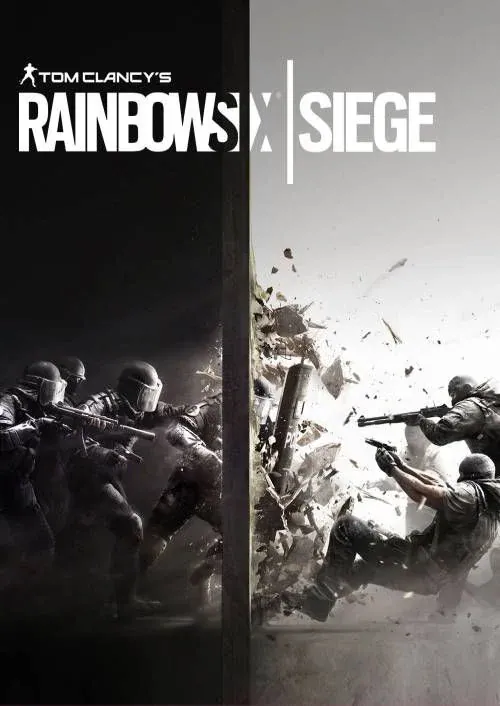
Tom Clancy's Rainbow Six Siege
2015 · Ubisoft MontrealUbisoft Connect
A revolutionary tactical FPS built around destructible environments, strategic depth, teamwork and high-stakes competitive gameplay.
- My rating
- 8.5/10
- Status
- Playing
- Rank reached
- Diamond
- Playtime
- 3468 h
My take
Personal review of Tom Clancy's Rainbow Six Siege
Tom Clancy's Rainbow Six Siege is arguably one of the competitive shooters I've invested the most time in throughout my gaming history. With over 3,000 hours played and experience competing at relatively high ranks, I can confidently say that it is one of the multiplayer games I've enjoyed the most over the years. Ubisoft accomplished something particularly difficult: reinventing the concept of tactical FPS gameplay by introducing an experience that, while sharing some fundamental principles with titles such as Counter-Strike 2 and Valorant, developed such a distinctive identity that it practically established its own subgenre.
Its greatest strength lies in the depth of its gameplay mechanics. Unlike most competitive shooters, where aiming precision and reflexes are often the predominant factors, Siege places planning, communication, map knowledge and adaptability at the very centre of the experience. Every match feels like an ongoing chess game between Attackers and Defenders, where even the smallest mistake can compromise an entire round. The ability to destroy significant portions of the environment, create new lines of sight, exploit verticality and fundamentally alter the geometry of maps is one of the game's most brilliant design decisions. This is further complemented by its Operator system, with each character bringing unique gadgets and abilities that dramatically expand strategic possibilities, making team composition and Operator selection essential elements of competitive success.
This combination of mechanics is precisely what gives Siege its exceptionally steep learning curve, while also providing a level of competitive depth that is extremely difficult to replicate. Understanding maps, mastering rotations, anticipating enemy strategies, managing resources and coordinating with teammates are all skills that require hundreds, if not thousands, of hours to truly master. Experience genuinely makes a difference, and even after investing an enormous amount of time, there are always new strategies and approaches to discover. Personally, this is precisely what kept me coming back for so many hours.
Another aspect that deserves particular recognition is Ubisoft's post-launch support. Released in December 2015, Siege has managed to maintain a competitive presence and an active community for over a decade, an extraordinary achievement in the multiplayer FPS landscape. Throughout the years, the game has received an enormous number of updates, new Operators, maps, map reworks, balancing adjustments and improvements to its competitive features. I've always particularly appreciated the studio's willingness to continue investing in a project that, especially during its early stages, had not yet achieved the level of success and popularity it would eventually reach. This journey entered another important phase with Siege X in 2025, introducing a major technical and visual overhaul, modernised maps and further improvements to the core experience. And the support hasn't stopped there: throughout 2026, its eleventh year of content, Ubisoft continues to introduce new Operators, competitive updates and structural changes. This is an ongoing commitment that I genuinely consider remarkable.
Of course, the experience is far from flawless. Throughout its lengthy lifespan, Siege has gone through several difficult periods, characterised by balancing issues, bugs, controversial gameplay changes and a considerable presence of cheaters and toxic behaviour. The continuous expansion of its Operator roster has also made maintaining a satisfactory level of balance increasingly challenging, with several Ubisoft decisions generating considerable debate within the community. Not every update has been particularly well received, and some changes have occasionally pushed the game away from the original experience that so many players had come to appreciate.
Despite these shortcomings, Rainbow Six Siege remains an extraordinary experience and one of the finest competitive FPS games of its generation. It managed to establish a unique identity, reinvent an entire genre and, most importantly, sustain its competitive formula for an exceptionally long period of time. The over 3,000 hours I've invested in it are perhaps the most concrete testament to how much I've enjoyed this game. I don't consider it perfect, nor do I believe every decision made by Ubisoft was necessarily the right one, but its contribution to the competitive shooter landscape and the quality of its fundamental gameplay mechanics are difficult to dispute.