
Action · Adventure · Open World · Stealth · Third Person
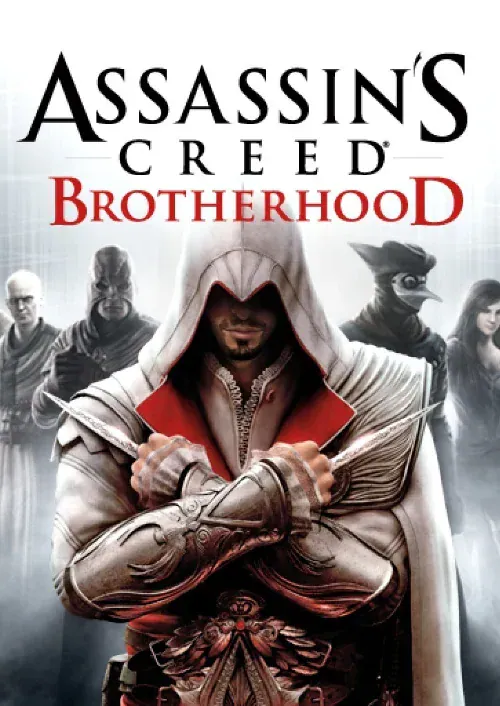
Assassin's Creed Brotherhood
2011 · Ubisoft MontrealUbisoft Connect
Continue Ezio Auditore's journey in Renaissance Rome. Rebuild the Assassin Brotherhood, recruit and train fellow Assassins, and dismantle the Borgia family's control in this action-packed open-world adventure.
- My rating
- /10
- Status
- Completed
- Completion
- Main story
- Playtime
- 26 h
My take
Personal review of Assassin's Creed Brotherhood
Assassin's Creed Brotherhood is a natural evolution of everything introduced in Assassin's Creed II and, in my opinion, one of the strongest entries in Ezio's trilogy. While it does not deliver a revolution comparable to its predecessor, it successfully refines the established formula and introduces some of the most interesting mechanics the franchise has ever seen.
The decision to set the entire adventure in Rome is particularly effective. The city is enormous, filled with historical landmarks, impressive architecture and beautiful scenery, capturing the atmosphere of Renaissance Italy remarkably well. The Colosseum, Castel Sant'Angelo, the Pantheon and other iconic locations make exploration an absolute pleasure. However, compared to the geographical variety of Assassin's Creed II, having a single main setting inevitably results in somewhat less environmental diversity.
Narratively, we find a more mature Ezio, now a Master Assassin. His conflict with the Borgia family, particularly Cesare and Rodrigo, provides a compelling continuation of the previous game's events. I particularly appreciate the protagonist's evolution: his motivations are no longer driven solely by personal revenge, as he gradually assumes greater responsibilities and becomes a leader within the Assassin Brotherhood.
The game's biggest gameplay addition is undoubtedly the recruitment system. Being able to identify new members, train them, increase their skills and summon them during combat is an incredibly enjoyable mechanic that introduces a new strategic dimension to the experience. The ability to rebuild and renovate Rome by purchasing buildings and businesses is another welcome addition, providing further incentives to explore the city.
The combat system, already improved in the previous installment, receives further refinements through chained executions, allowing players to eliminate entire groups of enemies in quick succession. It is a spectacular and satisfying mechanic, although it also makes encounters rather easy, particularly during the later stages of the game.
Another aspect worth highlighting is the soundtrack, once again composed by Jesper Kyd, which beautifully enhances the atmosphere. The art direction also remains one of the game's greatest strengths.
There are, of course, some shortcomings. Certain main missions feature overly restrictive optional objectives, combat can become repetitive, and having a single setting, despite its considerable size, occasionally limits environmental variety.
Nevertheless, I consider Assassin's Creed Brotherhood an excellent sequel and one of the franchise's finest entries. It further develops an already outstanding protagonist, introduces engaging mechanics and firmly establishes the identity of the series. Rome is an exceptional setting, and commanding an entire Brotherhood of Assassins remains one of the most satisfying experiences the franchise has ever offered.