
Action · Adventure · Exploration · Open World · RPG · Soulslike · Third Person
ELDEN RING
2022 · FromSoftware, Inc.Steam
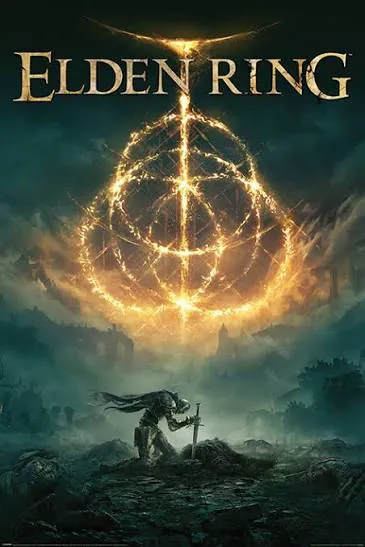
A monumental open-world action RPG featuring breathtaking art direction, deep lore and challenging combat. Explore the Lands Between, uncover an intricate mythology shaped by George R. R. Martin and Hidetaka Miyazaki, and forge your own path towards becoming Elden Lord.
- My rating
- /10
- Status
- Completed
- Completion
- Main story + side quests
- Playtime
- 134.3 h
My take
Personal review of ELDEN RING
Elden Ring is, without a doubt, one of the most ambitious and fascinating worlds I have ever had the pleasure of exploring. It earns a very high score from me purely on the strength of its lore and the extraordinary quality of its art direction. It is not a flawless game, nor do I consider it as revolutionary as it is often portrayed, but very few titles have captivated me with the same intensity as the Lands Between.
The first aspect that won me over is its mythology. Elden Ring's lore is immense, both in the construction of the world and in the stories of the individual characters who inhabit it, and it is undoubtedly the aspect I appreciate the most. The collaboration between Hidetaka Miyazaki and George R. R. Martin has produced an incredibly layered fictional universe in which virtually every character, including seemingly minor ones, hides a story, a history and motivations worth exploring, even if the player may meet them for only a few minutes.
Of course, not everything is perfect. The storytelling is extremely fragmented, and reconstructing the events of the game requires a considerable amount of effort: item descriptions, often cryptic dialogue and environmental details are not always enough to piece everything together. Personally, I had to rely on an external wiki to understand certain developments. It is a choice that belongs to the identity of FromSoftware's games, but I must admit I find it a debatable solution: having to turn to external sources to piece together a story of this quality does not entirely convince me.
The other major pillar of my evaluation is the art direction. The Lands Between are simply spectacular: certain locations leave a lasting impression through landscapes, architecture and visual compositions of rare beauty. Every region has a distinctive identity and atmosphere: some places inspire genuine wonder, while others evoke unease and desolation, but they all make the game world remarkably captivating.
From a purely technical standpoint, however, my assessment is considerably more restrained. The graphical presentation is not a strong point compared to other contemporary productions, and I would not consider Elden Ring a technological benchmark. This is precisely where the distinction between technical quality and art direction becomes apparent: the game may not impress through its technology, yet it still captivates through style, atmosphere and visual identity.
As for the gameplay, I do not consider Elden Ring an innovation. Essentially, it is Dark Souls on a much larger scale, built around a gameplay loop that remains unchanged from the opening hours to the very end. Combat, exploration, character progression and boss encounters all follow an established formula. The transition to an open world is undoubtedly the most significant departure from FromSoftware's previous titles, but I never genuinely felt that I was playing something entirely new.
Many consider Elden Ring the ultimate refinement of the Souls formula rather than a mere expansion of it, and I understand that perspective. I also recognize its significance within the soulslike genre and its place in video game history. Nevertheless, despite understanding the overwhelmingly positive consensus surrounding it, I would not consider it a Hall of Fame title when evaluated against the entire history of gaming. It is an exceptional game, but I do not believe every aspect of it reaches the same level.
Shadow of the Erdtree deserves particular attention. The expansion is a substantial addition, further developing the game's universe and shedding light on several aspects of its mythology left unresolved in the base game. Its new environments, characters and boss encounters enrich a world that still had plenty of stories to tell. Its almost unanimous critical reception, culminating in one of the highest Metacritic scores ever awarded to an expansion, confirms the quality of FromSoftware's work, although the difficulty of certain encounters divided the player base.
My main criticism, however, concerns the navigation of the new map, which I found, at times, a genuine ordeal. Its vertical design, multiple overlapping layers, hidden passages and scattered optional bosses, mausoleums and caves make exploration unnecessarily complicated on several occasions. Certain geographical connections are unintuitive, and some optional bosses are hidden in such obscure locations that consulting an external guide feels almost indispensable. In those moments, curiosity is not encouraged but turned into frustration.
Ultimately, Elden Ring is not a perfect game, and its gameplay does not reinvent the wheel. Nevertheless, the world FromSoftware has created, the depth of its mythology and the artistic identity of the Lands Between make it an experience I will remember for a long time. A very high score earned by the lore and the art direction, with the awareness that not everything surrounding them reaches the same level.